Requirements Analysis Before Software Development: Turning Business Ideas Into Technical Specifications
Learn how to turn a business idea into clear software requirements, workflows, acceptance criteria, technical specifications, estimates, and a traceable development plan.
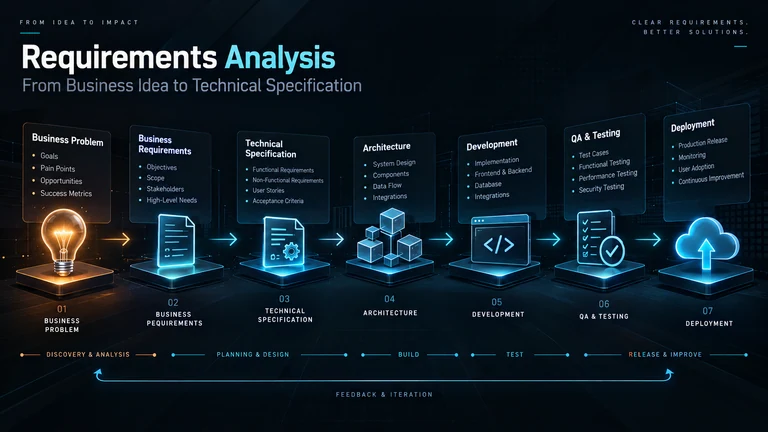
A software project rarely fails because developers cannot write code. It often fails because the team started writing code before everyone agreed on what the software was supposed to do.
Why requirements analysis matters
Requirements analysis is the work of turning a business idea into something a team can build and test. It means discovering the business problem, the users and their rules, the workflows, the constraints and the acceptance criteria, so that the product owner, designer, developer, tester and client all read the idea the same way. It is the core of requirements engineering.
Skipping it does not save time. It moves the questions into development, where every answer costs rework. The process below applies to web applications, SaaS products, internal business systems and customer portals.
From business idea to buildable specification
A business idea usually begins as one sentence: “We need a customer portal.” The common mistake is to jump straight to screens such as a login page, a dashboard, reports and an Excel export. Those are solution components. They do not explain the problem the software is meant to solve.
Discovery asks different questions:
- What business problem exists today, and who experiences it?
- Which process is manual or inefficient, and what information moves through it?
- What rules cannot be violated, and which systems must be integrated?
- How will the client know the project succeeded?
“Build a customer portal” is vague. This is more useful:
Customers need a secure portal where they can view their open requests, upload supporting documents, see request status, respond to clarification questions and download completed documents without relying on email for every interaction.
That statement already exposes users, actions, information, workflow and security expectations. It is the beginning of a specification.
Build a requirements hierarchy
A hierarchy stops a project from jumping straight from a business request to implementation details:
Business objective → User need → Business process → System capability → Functional requirement → Acceptance criterion
| Level | Example |
|---|---|
| Business objective | Reduce email-based customer service work |
| User need | Customers need to see the status of their requests |
| Business process | Request submission → review → clarification → completion |
| System capability | Customer request management |
| Functional requirement | Customer can view current status and status history |
| Acceptance criterion | Given an authenticated customer, when they open a request, then the current status and previous status changes are displayed |
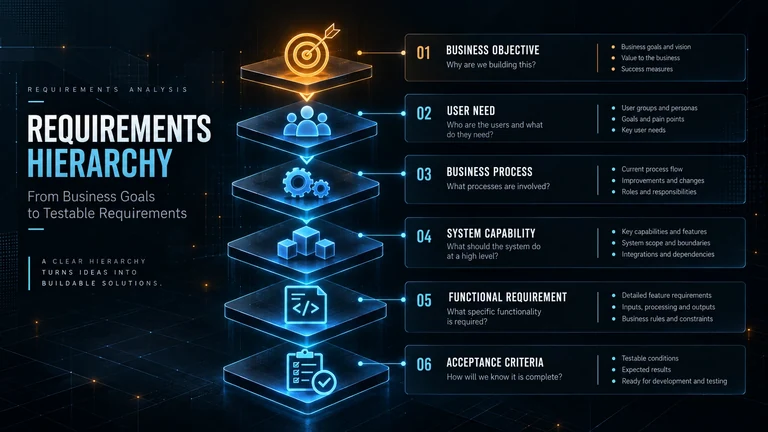
Each level answers the question above it, which keeps technical work tied to the business objective. A feature that cannot be traced back to a real need should be questioned before it consumes development time.
Roles belong here too. “User” is rarely enough: customers, employees, managers, administrators, service accounts and external integrations each need defined permissions, enforced at the application and API level rather than only by hiding buttons.
Define functional and non-functional requirements
Functional requirements describe what the system does. Non-functional requirements describe how well it must do it, and under what constraints.
Functional:
- A customer can create a support request.
- A manager can assign a request to an employee.
- The customer receives an email when the status changes.
- An administrator can deactivate a user.
Non-functional:
- The application must use HTTPS, and passwords must not be stored in plaintext.
- The API must enforce authorization independently of the user interface.
- A dashboard should load within an agreed performance target under the expected workload.
- Important actions must be recorded in an audit log.
- The application must remain usable on supported mobile screen sizes.
A feature can be functionally correct and still fail the project. “Users can upload documents” is incomplete until someone answers the hidden questions: which file types and sizes, who can upload and download, whether versions are kept, whether files are scanned, where they are stored, and what happens when an upload fails.
Three areas deserve explicit requirements early because they drive architecture and estimation:
- Data. For each important entity, define fields, relationships, ownership, access and retention. This often exposes gaps before database work begins.
- Integrations. Define authentication, error responses, retries, timeouts and failure recovery. If a portal reads from an external ERP system, decide what happens when the ERP is unavailable: show the last synchronized value, display an error, queue the request, or block the user.
- Security and performance. Identify authentication, sessions, authorization, audit logging and file-upload controls. “Fast” is not a requirement. Response time, concurrent users and availability should be agreed, measurable and testable, taken from the project's real context rather than invented to look precise.
Define acceptance criteria
Acceptance criteria are one of the strongest controls against “I thought you meant something else.” A good criterion describes observable behaviour:
Given [starting condition]
When [action]
Then [expected result]
For example:
Given a customer has an open request, when the assigned employee changes the request status to Completed, then the system records the completion timestamp, changes the request status, and sends the configured notification to the customer.
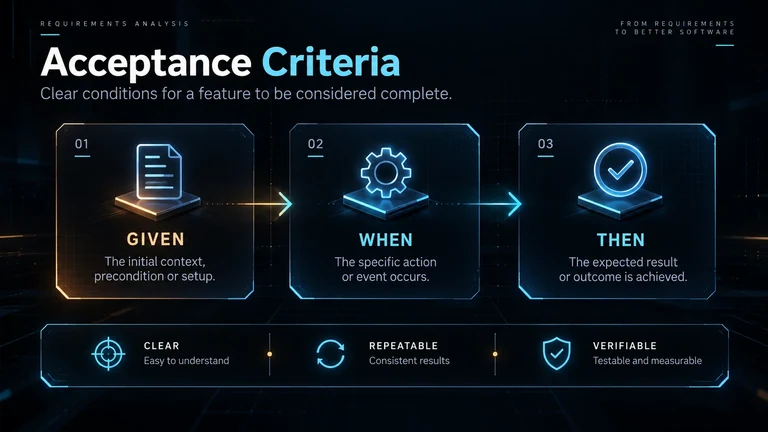
Cover more than the happy path: invalid input, missing data, unauthorized access, duplicate submission, integration failure, timeouts, expired sessions and concurrent updates. The more important the workflow, the more valuable explicit criteria become.
Create requirements traceability
A Requirements Traceability Matrix (RTM) connects each requirement to its implementation and its verification:
| ID | Requirement | Module | Test and status |
|---|---|---|---|
| REQ-001 | Customer can create request | Request module | TC-001 · Pass |
| REQ-002 | Manager can assign request | Assignment module | TC-002 · Pass |
| REQ-003 | Customer receives completion notification | Notification service | TC-003 · Pending |
| REQ-004 | Unauthorized users cannot access another customer's request | Authorization layer | TC-004 · Pass |
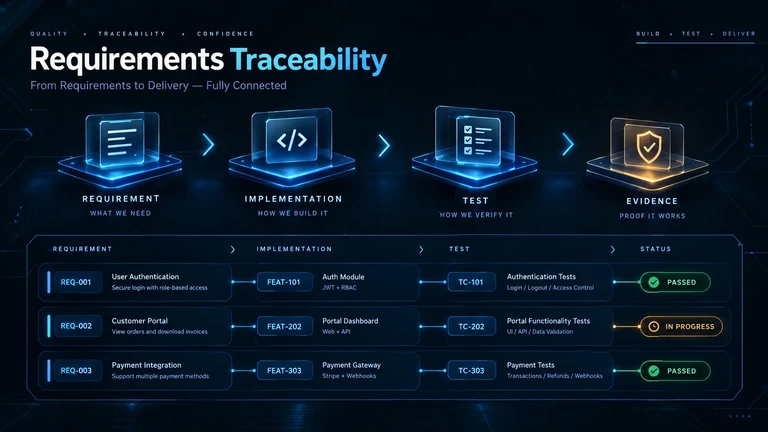
The matrix creates a chain: Requirement → Implementation → Test → Evidence. It matters most once a project grows beyond a small team, because anyone can see what was requested, where it was built and how it was verified.
Decompose complex features
A requirement such as “build customer management” is too large to estimate or test reliably. Break it into capabilities (create, view, edit, deactivate, search, view history, export), then into specific requirements:
The system shall allow an authorized manager to deactivate an active customer record.
Its acceptance criteria might be that the system asks for confirmation, the customer becomes inactive, the record stays available in historical reporting, and the action is written to the audit log. Now the requirement is observable and testable.
The same method turns “a portal where customers can manage their service requests” into a structure developers can work from:
- Objective: reduce manual email communication and give customers visibility into request progress.
- Actors: customer, support employee, support manager, administrator.
- Capabilities: authentication, requests, documents, notifications and administration.
- Workflow: Draft → Submitted → Under Review → Clarification Required → In Progress → Completed → Closed.
- Data: customer, user, request, status history, comment, attachment, notification and audit event.
- Security: customers see only their own records, employees see assigned or permitted records, managers see team records, and administrative actions are audited.
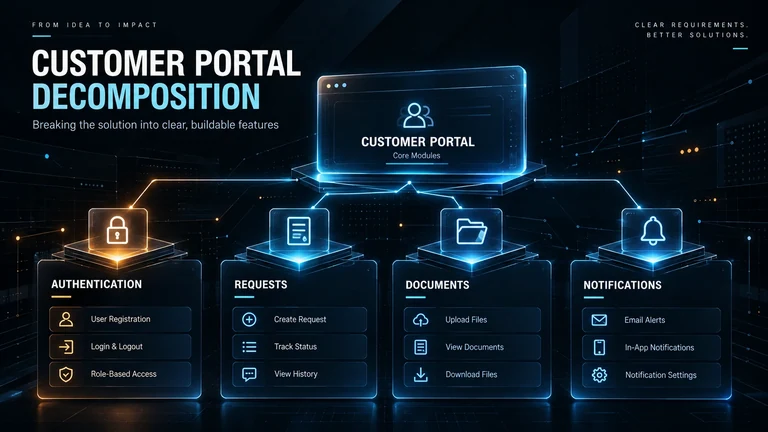
Define the workflow before the screens. For each state change, decide who can make it, what conditions allow it, what notification it triggers, whether it can be reversed and whether it is recorded. That state model later guides UI design, API behaviour, database design and QA.
Validate requirements before development
Before development starts, a few checks show whether the specification is ready for software development planning:
- Scope. Separate must-have, should-have and could-have items, and record what is deliberately “not now.” A customer portal MVP might need authentication, request creation and status, document upload, notifications and basic administration, with advanced analytics deferred.
- Estimation. Estimate components such as authentication, requests, documents, notifications, administration, integrations, QA and deployment, rather than one line like “Customer portal, 6 weeks.” Requirements analysis does not remove uncertainty. It makes it visible.
- Change control. Requirements change because businesses change. The problem is uncontrolled change. For each change, ask what is affected (requirements, modules, integrations, data, security) and what it does to effort and the delivery date.
- Readiness. Can the team say who the roles are, what the main workflows and failure paths are, what is deferred, and how each requirement will be tested?
If those questions cannot be answered, the project is probably not ready for unrestricted development.
The goal is less ambiguity, not more documentation
Requirements analysis becomes bureaucratic when documents are written for their own sake. The aim is not a 100-page specification nobody reads. It is to remove ambiguity where ambiguity would create cost.
A good requirement tells the client what will be delivered, the project manager what is in scope, the designer which workflow to support, the developer what to build, the tester what to verify and the security reviewer what to protect.
Conclusion
Requirements analysis is not a delay before “real development.” It is part of development. The earlier the links between the business problem, workflows, requirements and tests are explicit, the fewer assumptions have to be discovered along the way. It gives the team a clearer target, the client a more measurable scope and the project a basis for testing what was actually requested. For the kind of software systems, ERP and automation work this process supports, see Shahzad's background and work.
Turn an idea that people can discuss into a specification that people can build and test.
FAQ
What is requirements analysis in software development?
It is the process of discovering, documenting and validating what a software system needs to accomplish. It covers business needs, users, workflows, functional and non-functional requirements, data, integrations and acceptance criteria.
Why should requirements be analyzed before coding?
Coding against ambiguous requirements creates rework. Analysis exposes missing rules, permissions and edge cases before they become expensive implementation changes.
What is the difference between functional and non-functional requirements?
Functional requirements describe what the system does, such as a customer creating a request. Non-functional requirements describe how well it must do it, such as security, performance and usability.
What are acceptance criteria?
They are the observable conditions that must be met for a requirement to count as complete. Written as Given, When, Then statements, they give implementation and testing a shared basis.
What is a Requirements Traceability Matrix?
An RTM links requirements to implementation components and test cases. It helps show that important requirements were built and verified.
Can requirements change after development starts?
Yes, and they often should when business needs change. The important part is to assess the impact and record the decision instead of allowing uncontrolled scope changes.