SEO Is Changing: How AI Search and GEO Are Reshaping Website Visibility
SEO is expanding, not ending. Learn how AI search and GEO change website visibility, and how clear answers, topic depth and structured data prepare your site.
Search is changing.
For years, businesses approached Google visibility with a relatively straightforward objective: identify the right keywords, create optimized pages, build authority, and improve rankings.
That model still matters. But it is no longer the complete picture.
People are increasingly searching through AI-powered experiences that do more than return a list of blue links. Instead, these systems interpret a question, combine information from multiple sources, and produce an answer that may satisfy the user before they ever visit a website.
This creates a new challenge for businesses and website owners:
How do you make your website useful not only to search engines, but also to the AI systems that increasingly influence how people discover information?
This is where AI search, AI visibility and Generative Engine Optimization (GEO) become important.
Traditional SEO Still Matters
It is tempting to think that AI search means traditional SEO is finished.
It does not.
Technical SEO, useful content, crawlability, internal linking, structured data, page performance and authority remain important foundations. Search engines and AI systems still need to discover, interpret and evaluate information.
The difference is that visibility is becoming broader than a single ranking position.
Previously, a business might ask:
“What position does my page have for this keyword?”
Today, it is increasingly useful to ask:
“Does my business appear when someone asks an AI system a question related to what I do?”
Those are different questions.
A page can rank well for a keyword and still provide little value when an AI system is trying to construct an answer. Conversely, a well-structured and authoritative page may become a useful source for answering more conversational and complex queries.
The goal, therefore, should not be to abandon SEO.
It should be to build websites that are understandable, useful and trustworthy across both traditional search and AI-assisted discovery.
What Is AI Search?
Traditional search generally works by matching a user’s query with indexed pages and presenting relevant results.
AI search adds another layer.
Instead of simply returning pages, an AI-powered search experience can interpret the intent behind a question, identify relevant information, synthesize material from multiple sources and present the result in a conversational format.
Consider the difference between these two searches:
“software project management services”
and:
“What should a growing healthcare company consider before starting a custom software project?”
The second question contains more context and requires more reasoning.
A useful answer may need to discuss requirements, workflows, integrations, security, scalability, implementation, project management and ongoing operations.
This is where well-organized content becomes particularly valuable.
A website that clearly explains these subjects gives search and AI systems more meaningful information to understand and potentially reference.
What Is GEO?
Generative Engine Optimization, commonly shortened to GEO, is an approach to improving how content can be understood, retrieved and potentially represented by generative AI and AI-powered search experiences.
It should not be treated as a replacement for SEO.
Think of it as an extension of the same underlying objective:
Make your information easy for machines to understand and genuinely useful for people.
Traditional SEO may focus heavily on questions such as:
- What keyword does this page target?
- Can search engines crawl the page?
- Is the page technically sound?
- Does the content satisfy search intent?
- Are authoritative websites linking to it?
GEO adds questions such as:
- Does the page provide a clear answer to important questions?
- Are concepts explained without unnecessary ambiguity?
- Can important facts be easily identified?
- Does the page demonstrate real expertise or experience?
- Is the information supported by credible evidence where appropriate?
- Can an AI system understand the relationship between the business, its services, people and topics?
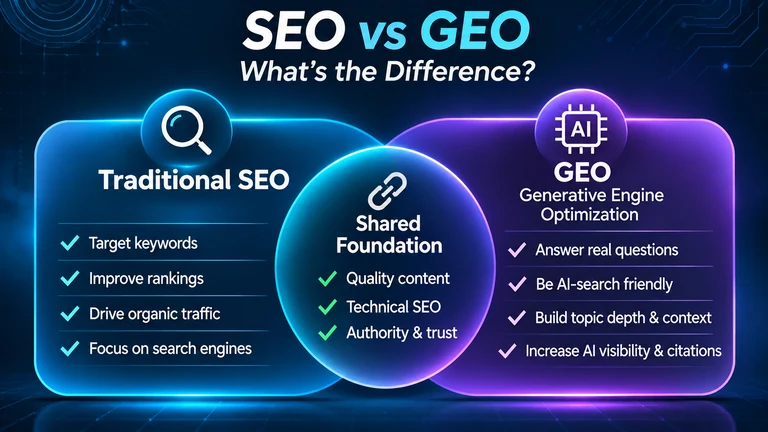
This changes how content should be planned.
From Keywords to Questions and Entities
Keywords remain useful, but they are only one part of the picture.
A modern content strategy should also consider the questions people ask, the problems they are trying to solve and the entities involved in the subject.
For example, someone researching an ERP implementation may not search the same phrase repeatedly.
They might ask:
- What does an ERP implementation involve?
- How long does an ERP implementation take?
- What should be included in ERP requirements?
- Why do ERP projects fail?
- How should an ERP system be integrated with existing software?
- Who should manage an ERP implementation?
These questions are related.
A strong article does not need to create six thin pages simply because there are six different search queries.
Instead, one comprehensive resource can address the broader subject and answer the important questions naturally.
This creates content that is useful to readers while giving search and AI systems a clearer understanding of the subject.
Answer the Question Clearly
One of the simplest improvements businesses can make is also one of the most frequently overlooked:
Answer the question directly.
Many websites spend several paragraphs introducing a subject before explaining what the visitor actually wants to know.
That approach can make content difficult for both people and machines to interpret.
A better structure is often:
- Question or topic
- Direct answer
- Explanation
- Evidence or examples
- Practical considerations
- Related questions
The reader should not have to search through five paragraphs to discover the main point.
For example:
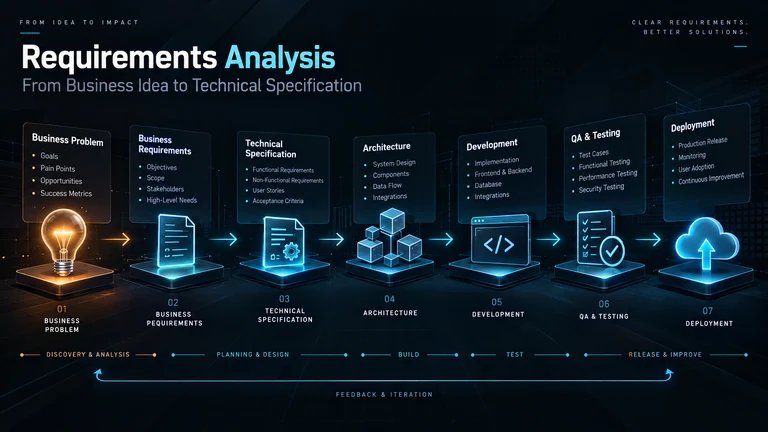
What Is Requirements Analysis?
Requirements analysis is the process of identifying, documenting and validating what a software system needs to accomplish before development begins.
The process typically examines business objectives, user needs, workflows, functional requirements, non-functional requirements, integrations, constraints and acceptance criteria.
The answer comes first.
The supporting explanation follows.
This structure works well for humans and creates clearly identifiable information that automated systems can interpret more easily.
Build Topic Depth Instead of Producing Thin Content
Publishing dozens of short pages targeting slightly different keyword variations is becoming a weaker long-term strategy.
A better approach is to develop genuine topic depth.
Suppose a company provides software project management services.
Instead of producing separate, shallow articles for:
- software project management
- software project planning
- software delivery management
- software development management
- technology project management
the company can build a meaningful knowledge base covering the actual problems involved.
That could include:
- Requirements analysis
- Project planning
- Technical architecture
- Development workflows
- Team management
- Quality assurance
- Deployment
- Technology operations
- System integrations
- ERP implementation
- Business process automation
- AI/ML projects
These subjects reinforce one another.
Together, they communicate something much stronger than a collection of keyword-focused pages.
They demonstrate knowledge of the broader field.
Demonstrate First-Hand Experience
AI-generated content has made one thing increasingly important:
Experience.
There is a major difference between explaining a subject from generic information and explaining it from years of actually managing projects, teams, systems and business requirements.
Experience can appear through:
- Real examples
- Project lessons
- Practical workflows
- Common implementation problems
- Decisions made during projects
- Mistakes to avoid
- Before-and-after scenarios
- Technical trade-offs
- Business consequences
This does not mean publishing confidential client information.
It means using legitimate experience to explain how things work in the real world.
For example, instead of saying:
“Requirements are important for successful software development.”
A more useful explanation might discuss what happens when requirements are incomplete, how ambiguities affect estimation, why scope changes occur and how acceptance criteria can reduce misunderstandings between business and development teams.
That is much more valuable than repeating a generic definition.
Structure Content for Humans First
GEO should never become an excuse for writing content that sounds like it was created for machines.
The primary audience is still the human reader.
Good AI-ready content is usually good human-readable content.
Use:
- Clear headings
- Short paragraphs
- Descriptive subheadings
- Lists where appropriate
- Tables when comparison is useful
- Definitions for technical terms
- Examples
- Logical progression
- Concise answers
- Supporting detail where necessary
Avoid filling pages with repetitive keywords simply because a keyword tool suggests a particular density.
Write naturally.
Explain the subject properly.
Make the information easy to navigate.
Structured Data Helps Machines Understand Context
Structured data is another important part of a modern website.
Schema markup can provide additional context about what a page represents.
Depending on the page, that might include information about:
- A person
- An organization
- An article
- A website
- A product
- A service
- Frequently asked questions
- Breadcrumbs
Structured data should accurately describe the visible content.
It is not a shortcut for making a weak page rank.
Its purpose is to provide machines with additional context and relationships between entities.
For example, a personal website can establish a relationship between a person, their organization, their website and their professional content.
That context becomes increasingly valuable as search systems become better at understanding entities rather than simply matching strings of keywords.
Internal Linking Creates a Knowledge Structure
Internal links are often treated as a simple SEO tactic.
They are more important than that.
Good internal linking helps readers move from one related subject to another while also creating a logical structure for the website.
Imagine an article about requirements analysis linking to articles about:
- Software development
- Project management
- Technical architecture
- Business process automation
Those relationships help establish the broader subject covered by the website.
Internal linking should therefore be intentional.
Do not add links simply because a page exists.
Link when the destination provides useful additional context.
Keep Important Information Accessible
A common mistake is hiding important information behind unnecessary interaction.
For example, critical explanations should not depend entirely on:
- JavaScript tabs
- accordions
- animated interfaces
- hover states
- dynamically loaded content
Interactive elements can improve user experience, but the fundamental information architecture should remain understandable.
Important content should be accessible to both users and automated systems.
The simpler the underlying structure, the easier it generally is to maintain, crawl and understand.
AI Visibility Is Not a Guaranteed Ranking Position
One important distinction should be made.
There is no simple formula that guarantees:
“Do these ten things and ChatGPT will cite your website.”
AI search systems use different technologies, indexes, retrieval mechanisms, models and ranking processes.
Their behaviour can also change.
Therefore, businesses should be cautious about anyone promising guaranteed AI citations or guaranteed inclusion in AI-generated answers.
The better strategy is to build strong underlying assets:
- Accurate information
- Original expertise
- Clear content
- Strong technical foundations
- Recognizable entities
- Authoritative references
- Consistent business information
- Useful internal linking
- Good structured data
- Strong user experience
These fundamentals have value regardless of which search interface a person uses.
GEO Is Not About Writing for Robots
This is perhaps the most important principle.
Do not rewrite every page to sound artificial because you want an AI system to understand it.
AI systems are becoming better at understanding natural language.
The objective should be clarity, not robotic writing.
Compare:
“Software project management solutions leverage optimized methodologies for facilitating project lifecycle execution.”
with:
“Software project management connects planning, development, people and delivery so that a software project moves from requirements to a working system.”
The second sentence is easier to understand.
It is also easier for a person to read.
Clarity wins.
A Practical AI-Search Readiness Checklist
Before publishing an important page, I would review it against a simple checklist.
Content
- Does the page answer a real question or solve a real problem?
- Is the main subject immediately clear?
- Are important questions answered directly?
- Does the page contain useful depth rather than repetition?
- Does it include original experience or meaningful insight?
Structure
- Is there one clear primary heading?
- Are sections logically organized?
- Are headings descriptive?
- Are paragraphs reasonably concise?
- Are lists and tables used where they improve understanding?
Technical SEO
- Is the page crawlable?
- Is the canonical URL correct?
- Is the title descriptive?
- Is the meta description useful?
- Are images optimized and given meaningful alternative text?
- Are internal links relevant?
- Is structured data accurate?
Trust and authority
- Is the author identifiable?
- Is the organization clearly identified?
- Are claims supported where appropriate?
- Does the site provide evidence of real expertise?
- Is business information consistent across the website?
AI visibility
- Can an AI system easily identify what the page is about?
- Are important concepts explained explicitly?
- Are related concepts connected naturally?
- Does the page provide information worth referencing?
- Does the content add something beyond generic information already available everywhere?
The Real Goal: Become a Useful Source
The biggest mistake businesses can make with GEO is treating it as another keyword trick.
The objective should be bigger.
Become a useful source of information.
If someone asks about software project management, your website should provide a meaningful explanation.
If someone asks about requirements analysis, your website should provide practical guidance.
If someone asks about ERP implementation, your website should demonstrate that you understand the business and technical challenges involved.
If someone asks about AI implementation, your content should explain the opportunities, limitations and operational considerations rather than simply using “AI” as a marketing keyword.
That is the foundation of long-term visibility.
SEO, GEO and the Website as a Knowledge Base
A modern business website is no longer just a digital brochure.
It can become a structured knowledge base representing:
- What the company does
- Who it serves
- What problems it solves
- How its services work
- What its people know
- What experience it has
- What systems it builds
- What questions its customers ask
Traditional search can use that information to determine relevance.
AI-powered systems can use it to understand the business and its expertise.
People can use it to make decisions.
That is a much stronger outcome than optimizing a page for a single keyword.
Conclusion
SEO is not disappearing.
It is expanding.
The fundamental principles of technical SEO, useful content, authority and a good user experience remain important. But search is becoming more conversational, contextual and increasingly influenced by AI-generated answers.
That means businesses should start thinking beyond rankings.
The question is no longer only:
“Can people find my website?”
It is also:
“Can search engines and AI systems understand what I know, what my business does and why that information is useful?”
That is where SEO and GEO meet.
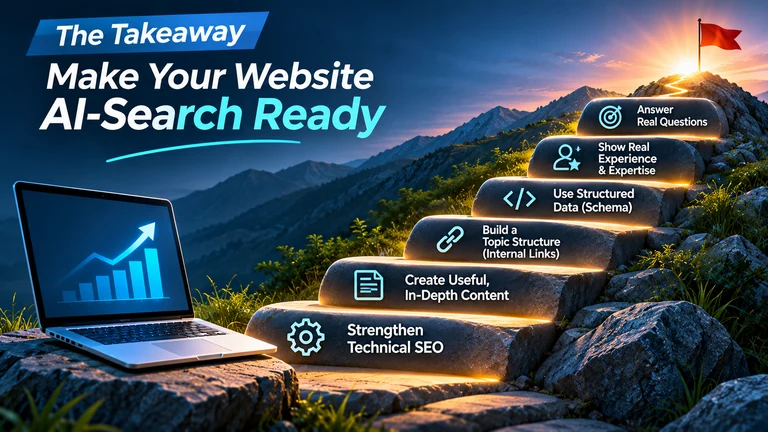
Build technically sound websites.
Create genuinely useful content.
Explain complex subjects clearly.
Demonstrate real experience.
Connect related information.
Make your people and organizations identifiable.
Keep your structured data accurate.
And most importantly, create something worth discovering and referencing.
The technology behind search will continue to change.
A website built around clarity, expertise and useful information has a much better chance of adapting with it.