Managing Technical Teams: How to Balance Accountability, Autonomy, and Delivery
How software project and operations managers balance accountability, autonomy and delivery: clear requirements, priorities, planning, quality and metrics.

Managing a technical team involves much more than assigning tasks, checking progress, and ensuring deadlines are met. Software projects require coordination between people, technical decisions, business requirements, dependencies, and delivery expectations. When these elements are not aligned, even a technically capable team can struggle to produce consistent results.
The challenge for a software project manager or operations manager is to create an environment where people understand what needs to be delivered, have the information and support required to do their work, and remain accountable for their commitments.
Effective technical team management is not about controlling every activity. It is about creating the conditions in which teams can work independently while remaining aligned with business objectives.
Why Managing Technical Teams Is Different
Technical teams often work on tasks that are interconnected, complex, and difficult to estimate precisely. A seemingly small change can affect an existing feature, introduce a dependency, or reveal a problem that was not visible during initial planning.
At the same time, businesses expect predictable timelines, regular communication, and measurable outcomes.
This creates several management challenges:
- Technical complexity can make delivery estimates uncertain.
- Requirements may change as the project progresses.
- Developers may depend on other team members, systems, or external services.
- Business stakeholders may expect progress before the technical work is fully understood.
- Poor communication can allow small blockers to become significant delivery risks.
Managing these challenges requires a combination of technical understanding, structured project management, operational discipline, and effective communication.
The objective is not to eliminate uncertainty. It is to identify it early, manage it transparently, and prevent it from disrupting delivery unnecessarily.
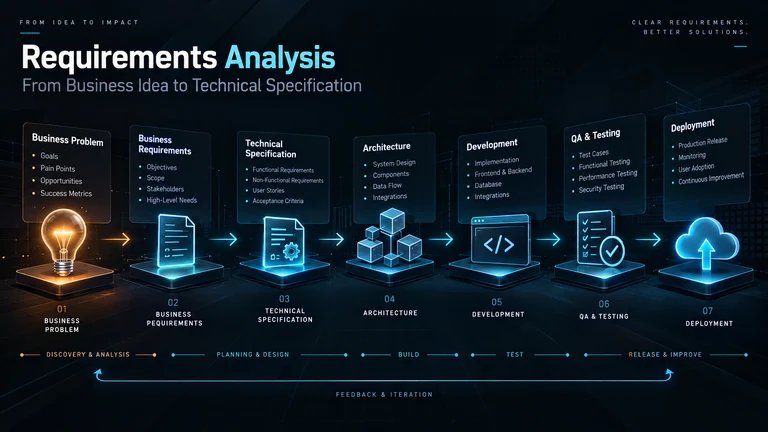
1. Establish Clear Requirements Before Assigning Work
Many delivery problems begin before development starts.
A task may appear straightforward to a business stakeholder but contain unanswered questions about functionality, integrations, permissions, data, or expected behaviour. If a team starts implementation without understanding these details, developers may make assumptions that later require rework.
Before assigning substantial development work, clarify:
- The business problem being addressed.
- The expected outcome and scope.
- Functional and non-functional requirements.
- Dependencies and integration points.
- Acceptance criteria and testing expectations.
- Known constraints, risks, and unanswered questions.
Not every detail must be resolved before work begins. However, the team should understand what is being built, why it matters, and how completion will be evaluated.
For larger initiatives, breaking work into smaller deliverables makes planning and progress tracking more reliable.
Clear requirements reduce ambiguity, improve estimation, and give technical teams a stronger foundation for making implementation decisions.
2. Set Priorities That Reflect Business Objectives
A team can be busy throughout the day and still make limited progress on the most important outcomes.
This often happens when priorities are unclear, new requests arrive continuously, or multiple stakeholders assign competing work directly to team members.
The manager’s responsibility is to establish a shared understanding of what matters most.
Priorities should consider business value, urgency, dependencies, risk, and available capacity. When a new request enters the workflow, its impact on existing commitments should be evaluated rather than automatically treating it as the next priority.
A practical approach is to distinguish between:
- Critical issues that require immediate attention.
- Planned work tied to agreed delivery milestones.
- Improvements that provide value but can be scheduled later.
- Requests that require clarification or additional approval.
This structure helps the team focus without ignoring genuine business needs.
It also gives managers a clear basis for explaining why some work must wait. Prioritisation is not simply deciding what to do first; it is managing the trade-offs between competing demands.
3. Give Developers Ownership Without Losing Visibility
Micromanagement often emerges when managers lack confidence in delivery or cannot see meaningful progress. The response may be to request constant updates, dictate implementation details, or monitor activity instead of outcomes.
This approach can create unnecessary interruptions and reduce the ownership expected from experienced developers.
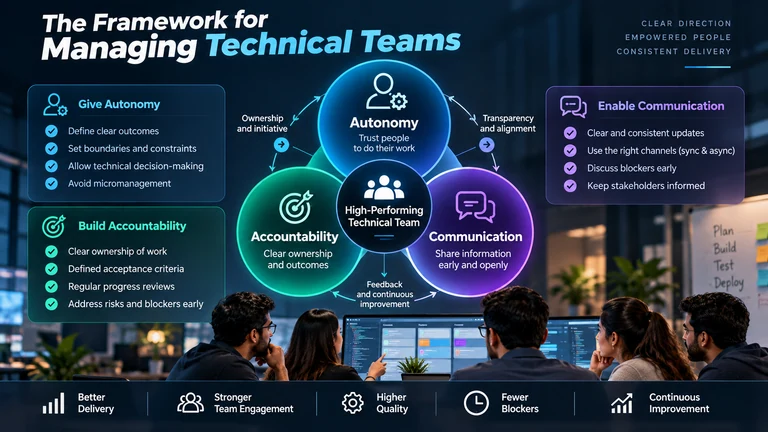
A better model combines clear expectations with appropriate autonomy.
Define the outcome, constraints, deadline, and acceptance criteria. Let the responsible team member determine the implementation approach within those boundaries, while keeping the manager informed about progress and risks.
Ownership should include responsibility for communicating blockers, identifying risks, raising concerns, and confirming when work is ready for review.
Autonomy does not mean working without coordination. It means allowing people to make decisions appropriate to their role while maintaining visibility into delivery.
Managers should intervene when decisions affect scope, security, architecture, dependencies, cost, or agreed commitments—not simply because an implementation differs from their preferred approach.
4. Build Accountability Around Outcomes
Accountability becomes difficult when responsibilities are vague or success is measured only by activity.
Completing assigned tasks is important, but task completion alone does not guarantee that the intended business result has been achieved.
A useful management framework establishes four things:
- Ownership: Who is responsible for the deliverable?
- Expected outcome: What must be achieved?
- Acceptance criteria: How will completion be verified?
- Commitment: When is the work expected, and what assumptions affect that date?
These expectations should be visible to the people involved.
Progress reviews should focus on completed work, remaining work, blockers, quality, and risks. When a commitment is missed, the discussion should identify what happened, what needs to change, and how the delivery plan should be adjusted.
Accountability is not about assigning blame. It is about making responsibilities clear, addressing problems honestly, and ensuring that agreed actions lead to measurable progress.
5. Use Meetings and Communication to Remove Blockers
Meetings are useful when they improve coordination or enable decisions. They become counterproductive when they repeatedly interrupt focused work without producing meaningful outcomes.
Technical teams need time for analysis, implementation, testing, code review, and problem-solving. A management process that consumes too much of this time can slow the very delivery it is intended to support.
Keep routine communication focused on practical questions:
- What has been completed?
- What is the next priority?
- Is anything blocked?
- Are there decisions or dependencies that require attention?
- Has anything changed that could affect delivery?
Daily updates can be brief, with deeper discussions reserved for issues that genuinely need them.
Use asynchronous communication for routine progress and documentation. Arrange focused discussions when a decision, technical explanation, or collaborative problem-solving session is necessary.
The manager’s role is to ensure that important information reaches the right people at the right time—not to make every conversation a formal meeting.
6. Plan Realistically and Manage Dependencies
A delivery date is only meaningful when it reflects the work involved, the team’s capacity, and the risks surrounding the project.
Unrealistic commitments often result from incomplete requirements, optimistic estimates, unaccounted dependencies, or pressure to promise dates before technical discovery has taken place.
Effective planning begins by understanding the scope and breaking work into manageable deliverables. Estimates should account for development, reviews, testing, integration, deployment, and necessary contingency.
Dependencies require particular attention. A task may be ready for development but still depend on an API, design approval, access credentials, infrastructure, or another team’s work.
Track these dependencies explicitly and assign responsibility for resolving them.
When circumstances change, communicate the impact early. Explain what has changed, how it affects the schedule, and which options are available.
Reliable project management does not mean guaranteeing that nothing will go wrong. It means making informed commitments, identifying delivery risks early, and adjusting plans before problems become surprises.
7. Make Quality Part of the Delivery Process
A feature that works in a developer’s environment is not necessarily ready for production.
Technical delivery includes testing, code review, security considerations, integration behaviour, documentation where required, and a reliable deployment process.
When quality checks are postponed until the end of a project, defects and integration issues can accumulate until they become expensive to resolve.
Managers should establish quality expectations appropriate to the project’s complexity and risk.
These may include:
- Defined acceptance criteria.
- Automated tests and appropriate manual testing.
- Code review and version control practices.
- Integration and regression testing.
- Security and performance checks.
- Deployment and rollback procedures.
- Clear ownership of production issues.
The aim is not to introduce unnecessary bureaucracy. It is to make quality a normal part of completing work rather than a separate activity performed only when time remains.
A realistic delivery plan must account for verification, not just implementation.
8. Measure Delivery, Not Just Activity
Operational visibility helps managers identify whether the team is making sustainable progress.
However, metrics can become misleading when they reward activity instead of outcomes. Counting hours, commits, or completed tickets in isolation does not provide a reliable picture of business value or software quality.
Choose a small set of indicators that support actual management decisions.
Depending on the team and project, these may include:
- Delivery against agreed milestones.
- Cycle time from starting work to completion.
- Work blocked by dependencies.
- Defects and rework.
- Planned versus unplanned work.
- Reliability of releases and production changes.
Use these indicators to identify patterns and improve the delivery process, not to rank individuals using simplistic comparisons.
For example, repeated delays may indicate unclear requirements, excessive work in progress, slow approvals, or an unstable technical environment. The appropriate response is to investigate the underlying cause rather than immediately assume that individual team members are underperforming.
Metrics are most valuable when they help the team make better decisions.
9. Align Technical Decisions With Business Needs
Technical excellence matters, but software is ultimately built to solve problems.
Teams can spend considerable time improving architecture, adopting new tools, or refining implementation details without evaluating whether those activities address the most important business needs.
Managers help maintain alignment between technical decisions and intended outcomes.
This does not mean sacrificing engineering quality for short-term deadlines. It means understanding trade-offs and making them explicit.
When evaluating a proposed solution, consider:
- Whether it satisfies the actual requirements.
- Its impact on reliability, security, and maintainability.
- Implementation effort and delivery risk.
- Integration with existing systems.
- Future operational and support costs.
- Whether a simpler approach can achieve the same outcome.
The right decision depends on context. A temporary workaround may be appropriate in one situation and unacceptable in another.
Strong technical management ensures that these decisions are made deliberately, with the relevant risks and business implications understood.
10. Create a Process That Supports Continuous Improvement
A management process should evolve as the team, product, and business grow.
Recurring delivery problems often reveal weaknesses in the working environment rather than isolated mistakes. Repeated scope changes may indicate a requirements problem. Frequent blockers may suggest unclear ownership or slow decision-making. Persistent defects may point to inadequate testing or unrealistic schedules.
Review completed work and identify what can be improved.
Useful questions include:
- What helped the team deliver successfully?
- Where did work become delayed or unclear?
- Which decisions arrived too late?
- What caused avoidable rework?
- Which process changes would make the next delivery more reliable?
Choose a small number of improvements, assign ownership, and evaluate whether they make a measurable difference.
Continuous improvement should make work clearer and more effective—not create an endless stream of new procedures.
Conclusion: Lead the System, Not Every Individual Task
Managing technical teams effectively requires a balance between direction and independence.
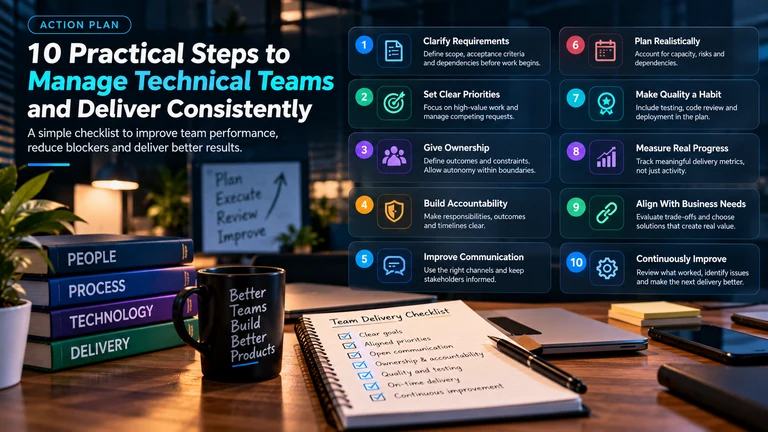
Clear requirements help teams understand what to build. Prioritisation keeps effort focused on business objectives. Accountability establishes ownership, while autonomy allows people to solve problems without unnecessary interference. Realistic planning, quality controls, and useful delivery metrics make progress more predictable.
These practices work together. None can compensate completely for the absence of the others.
For software project managers and operations managers, the goal is to establish a working environment in which people understand their responsibilities, can make informed decisions, communicate problems early, and deliver software that meets business expectations.
The strongest management approach is not the one that monitors every activity. It is the one that creates clarity, removes obstacles, manages risks, and enables the team to deliver consistently.
When the requirements are clear, priorities are realistic, and ownership is understood, technical teams can spend less time navigating confusion and more time producing meaningful results.