Why Software Projects Fail Before Development Even Begins
Discover why software projects fail before development starts, from unclear requirements and poor planning to scope creep, weak ownership and unrealistic expectations.

A software project can have talented developers, modern technologies and sufficient financial resources, yet still struggle to deliver the expected results.
The reason is often overlooked: many software projects encounter their biggest problems before development even begins.
Businesses frequently rush into implementation without fully understanding the problem they are trying to solve. Requirements remain unclear, expectations are unrealistic, responsibilities are undefined and important technical decisions are postponed.
By the time developers start building the solution, the project may already be carrying assumptions, risks and disagreements that eventually affect its delivery.
Software development is not simply about writing code. It is a structured process that connects business objectives, requirements, people, technology and execution.
Understanding why software projects fail before development begins is therefore essential for business owners, project managers, product owners and technology leaders.
Let’s examine the most common causes and what organizations should do differently.
1. Starting With a Solution Instead of Understanding the Problem
One of the most common mistakes in software projects is deciding what to build before understanding why it needs to be built.
A business may approach a development team with a request for a mobile application, an ERP system, a customer portal or a business automation platform.
However, the requested solution does not necessarily represent the actual business requirement.
For example, an organization may believe it needs a custom CRM system when its real problem is fragmented customer information, inconsistent sales processes or a lack of visibility across departments.
Building software without investigating these underlying problems can result in a technically functional product that does not solve the business challenge.
Before selecting a technology or defining features, project stakeholders should establish:
- What business problem are we trying to solve?
- Who experiences this problem?
- How is the current process working?
- What limitations exist in the current system?
- What measurable improvement should the new solution deliver?
- How will success be evaluated?
The objective is to understand the business need before translating it into a technical solution.
A well-defined problem creates a foundation for better requirements, architecture and project planning.
2. Unclear Requirements and Incomplete Specifications
Requirements are the foundation of software development.
When requirements are incomplete, inconsistent or based on assumptions, developers are forced to interpret what the business expects.
This creates unnecessary revisions, misunderstandings and disagreements during implementation.
Consider a simple requirement such as:
“The system should allow administrators to manage users.”
Although this sounds straightforward, several important questions remain unanswered.
- Can administrators create, edit and deactivate users?
- Are there different user roles and permissions?
- Can users belong to multiple departments?
- Is approval required before account activation?
- Should the system maintain an activity history?
- What happens when an administrator changes someone’s permissions?
Without these details, different stakeholders may have different interpretations of the same requirement.
A proper requirements process should cover:
Functional requirements
Define what the system must do, including features, workflows, user interactions and business rules.
Non-functional requirements
Establish expectations for performance, security, scalability, availability and usability.
User roles and permissions
Identify who will use the system and what each user is allowed to access or perform.
Business workflows
Document how information moves between departments, users and system components.
Acceptance criteria
Define the conditions that must be satisfied before a feature or deliverable can be accepted.
Requirements should be documented, reviewed and validated with the relevant stakeholders before development starts.
This is where business analysis becomes particularly important. It translates business expectations into structured specifications that technical teams can understand and implement.
3. Unrealistic Timelines, Budgets and Expectations
Another major source of project failure is committing to timelines and budgets without understanding the actual complexity of the work.
Businesses sometimes expect a complete software solution within an arbitrary deadline, even when the requirements, integrations and technical dependencies have not been properly evaluated.
Development estimates based only on the number of screens or features can be misleading.
A seemingly simple feature may require complex business logic, external integrations, database changes, security controls and extensive testing.
Before committing to a delivery schedule, project managers should consider:
- Requirements complexity and dependencies.
- Available development resources.
- Integration with existing systems.
- Third-party service limitations.
- Testing and quality assurance requirements.
- Stakeholder review and approval time.
- Deployment and post-launch preparation.
A realistic project plan should account for the complete delivery lifecycle rather than development activities alone.
Budget planning should follow the same principle.
The goal is not to create the most optimistic estimate. It is to establish a delivery commitment that the team can realistically achieve without compromising quality.
4. Scope Creep Starts Before Development
Scope creep is commonly associated with changes introduced during development, but its foundations are often established much earlier.
When project boundaries are not clearly defined, stakeholders may assume that additional features, integrations and workflows are automatically included.
For example, an organization initially requests an inventory management system. During discussions, the project gradually expands to include procurement, supplier management, accounting integration, reporting and mobile access.
Each addition may appear reasonable individually, but collectively they can significantly change the project’s complexity, budget and timeline.
To control scope effectively, project teams should establish:
- A clearly documented project scope.
- Features and deliverables included in the initial release.
- Explicit exclusions and limitations.
- Agreed project priorities.
- A process for evaluating new requests.
- An impact assessment for significant changes.
Not every requested feature needs to be included in the first release.
A phased delivery approach can help organizations prioritize essential functionality while allowing additional capabilities to be introduced in subsequent releases.
The important distinction is between controlled project evolution and uncontrolled scope expansion.
5. Missing Ownership and Decision-Making Authority
Software projects involve multiple stakeholders, including business owners, department heads, product owners, project managers, developers and external vendors.
However, having multiple stakeholders does not automatically create effective project governance.
Problems arise when nobody has clear authority to make decisions or approve requirements.
For example:
- Business stakeholders disagree about priorities.
- Developers wait for clarification.
- Project managers cannot obtain timely approvals.
- Nobody takes responsibility for final acceptance.
- Important decisions remain unresolved for weeks.
These situations create delays even when the development team is technically capable of progressing.
Before development begins, organizations should establish clear ownership.
This includes identifying:
Business owner: Responsible for the overall business objectives and expected outcomes.
Project manager: Responsible for planning, coordination, timelines, risks and delivery oversight.
Product owner or designated decision-maker: Responsible for prioritizing requirements and making product-related decisions.
Technical lead: Responsible for technical direction, architecture and implementation standards.
Stakeholders: Responsible for providing domain knowledge, reviewing requirements and participating in approvals.
Responsibilities should be documented so that everyone understands who provides input, who makes decisions and who approves deliverables.
Clear ownership reduces unnecessary delays and creates accountability throughout the project.
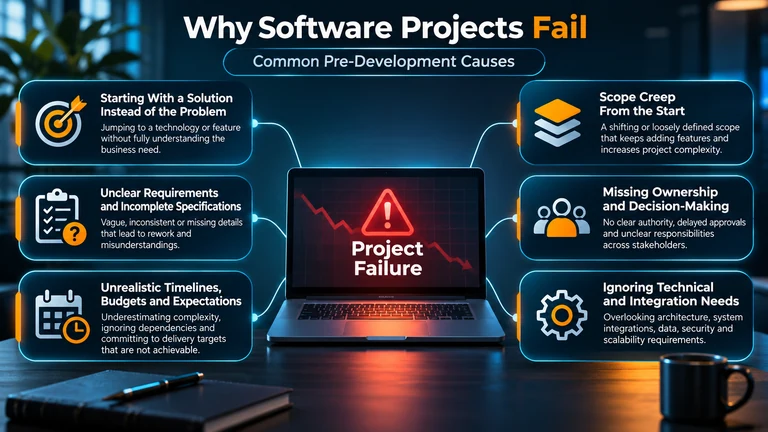
6. Ignoring Technical Architecture and Integration Requirements
A software solution may appear straightforward from a business perspective but involve considerable technical complexity.
Organizations sometimes postpone architectural discussions until development is already underway.
This can create problems when the team discovers that the proposed solution cannot easily support required integrations, data structures, security expectations or future growth.
Important technical considerations should be evaluated before implementation.
These include:
- Existing systems and third-party integrations.
- Database structure and data migration.
- Authentication and authorization.
- Security and privacy requirements.
- Expected user volume and performance.
- Infrastructure and hosting requirements.
- Scalability and maintainability.
- Backup and disaster recovery considerations.
Technology selection should follow business and technical requirements rather than personal preferences or temporary trends.
The objective is not to over-engineer a solution before development begins.
Instead, the technical team should establish an architecture that supports the agreed scope and provides a reasonable foundation for future development.
Early architectural decisions can prevent expensive structural changes later.
7. Treating Testing and Quality Assurance as an Afterthought
Quality assurance should not begin when development is almost complete.
If testing expectations are not established during planning, teams may struggle to determine whether a feature is actually complete or whether the delivered system meets business expectations.
For example, a developer may consider a user registration feature complete because users can successfully create accounts.
However, the business may also expect email verification, password recovery, duplicate-account prevention, role assignment and audit logging.
Without defined acceptance criteria, both parties may have different definitions of completion.
A project should establish its quality approach before implementation.
This includes:
- Defining acceptance criteria for major features.
- Identifying critical business workflows.
- Establishing functional and non-functional testing expectations.
- Planning integration testing.
- Defining user acceptance testing responsibilities.
- Preparing staging and production environments.
- Establishing a process for reporting and resolving defects.
Testing is not simply about finding errors.
It is about verifying that the software performs the intended business functions reliably and consistently.
8. No Clear Communication and Project Governance
Even well-planned software projects can experience problems when communication and governance are weak.
Development teams need timely decisions, clear priorities and consistent feedback from business stakeholders.
Without a structured communication process, important information can become scattered across emails, meetings and informal conversations.
This makes it difficult to track decisions, identify risks and understand the actual project status.
A practical project governance structure should include:
Regular progress reporting
Communicate completed work, upcoming activities, blockers and delivery status.
Risk and issue management
Identify potential problems early and assign responsibility for resolving them.
Decision tracking
Document important decisions, approvals and changes so that everyone works from the same understanding.
Stakeholder communication
Establish who needs updates, what information they require and how frequently communication should take place.
Escalation procedures
Define how unresolved issues and critical blockers should be raised and addressed.
Effective communication is not about increasing the number of meetings.
It is about ensuring that the right information reaches the right people at the right time.
9. What Should Happen Before Development Begins?
Before committing resources to implementation, organizations should complete a structured pre-development readiness assessment.
The following framework brings the most important preparation activities together.
The Pre-Development Readiness Framework
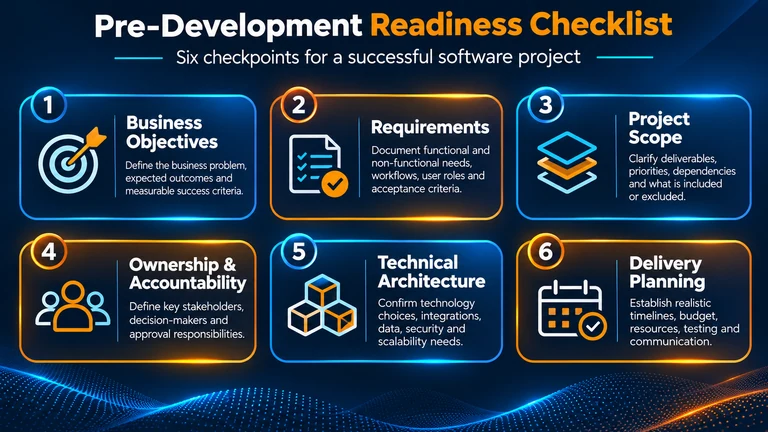
1. Business objectives
Establish the business problem, intended outcomes and measurable success criteria.
2. Requirements
Document functional requirements, non-functional requirements, workflows, user roles and acceptance criteria.
3. Project scope
Define deliverables, exclusions, priorities, dependencies and the expected release structure.
4. Ownership and accountability
Identify stakeholders, decision-makers, project leadership and approval responsibilities.
5. Technical architecture
Evaluate technology choices, integrations, data requirements, security and infrastructure.
6. Delivery planning
Establish realistic timelines, budgets, resources, testing activities, milestones and communication arrangements.
These six checkpoints provide a practical way to assess whether a project is ready to enter development.
They also help identify unresolved questions before those questions become expensive implementation problems.
A project does not need every minor detail finalized before development can begin. However, its fundamental business objectives, requirements, ownership, scope and technical direction should be sufficiently clear.
10. The Goal Is Not More Documentation. It Is Better Decisions.
One important distinction should be made: successful project preparation does not mean producing hundreds of pages of documentation.
Excessive documentation without meaningful analysis can become just as ineffective as having no documentation.
The real objective is to establish a shared understanding between business stakeholders and technical teams.
Everyone should know:
- What is being built.
- Why it is being built.
- Who will use it.
- What is included in the project.
- Who is responsible for decisions.
- How the solution will be implemented.
- What constitutes successful delivery.
The level of documentation should reflect the project’s complexity, risk and business importance.
A small internal application may require a relatively lightweight specification, while a large enterprise platform may need detailed requirements, architecture documentation, integration specifications and formal governance.
The right approach is to create enough structure to support informed decisions without slowing the project down unnecessarily.
Conclusion: Successful Delivery Starts Before the First Line of Code
Software project success is influenced by decisions made long before developers begin implementation.
Unclear requirements, unrealistic expectations, uncontrolled scope, missing ownership and insufficient technical preparation can create problems that become increasingly difficult and expensive to resolve as the project progresses.
Development teams cannot consistently compensate for a lack of business clarity or ineffective project governance.
Successful delivery requires alignment between business objectives, requirements, people, technology and execution.
Organizations that invest time in understanding their requirements, defining responsibilities and preparing a realistic delivery plan are better positioned to manage risks and achieve meaningful outcomes.
The goal is not simply to start development faster.
It is to start with the right understanding, the right priorities and a clear direction.
A successful software project does not begin when developers start writing code. It begins when the business understands what it needs, why it needs it and how the organization will deliver it.